Tuesday, February 22, 2011

A Conversation Blog # 5


Apple discusses conservative modernization with the notion from neoliberals that somehow opening up the realm of education to a "free market enterprise" and letting business be the deciding factor within curriculum development is ultimately damaging our education system. Bringing in Apple's discussion about "restoring our traditional common culture" would be where his conversation with Slattery would begin. Slattery may say something to the effect that although we may all live in the same country there is no true common culture. When using the autobiographical reflection forum when dealing with currere no two experiences will every be the same. Apple would agree, and discuss how this notion gives further credence to his argument that tightening the control of a school by the neoliberal outside influences is destroying a child's possibility of connecting and bonding with the curriculum we ultimately would like them to ascertain. Both would discuss the fact that although standardized tests give us baseline data to see how much of a connection a student has with pieces of curriculum in their life, Slattery would point out that each student's lived experiences in the past influence how they approach the standardized tests, and work their way through it. I imagine Slattery might point out that within the reading test for example, students who have world travel experience would better understand the abstract readings due to the fact that now these passages are more international and diverse in culture, whereas a student from the inner city would struggle with making a connection because his past lived experiences do not have a global background. Apple may then broaden his thoughts on why the conservative modernization is such a strong movement today is that although neoliberals say they want “no child left behind” what they are actually doing is intentionally leaving at least 1/3 of the student population behind with these rigorous tests which do not test basic ability, but actually contributes to a further widening of the socioeconomic class gap. Slattery would support this by saying in the currere “race to the top” we are really running away from what all children bring with them to the classroom. Some of their autobiographical reflections itself effects their ability to sit for two and half hours to take these state tests, which have been made to see if our children are living up to the conservative modernizations movements view of what the business world see as an effective future contributor to our economic society. Slattery would probably close with something to the effect that if we really want to make the conservative modernization movement explode we should enlist the students help in the development of curriculum in the post modern era since they are the ones who will have to live with it for the rest of their lives, become part of their regressive reflection on education. Unfortunately we have not come that far yet in our thinking.

Sunday, February 6, 2011

blog #4 part B


Well professional assumptions are easy to start with...professionally I expect the students I receive to have been taught the previous information required so we can continue in their currere through there educational experiences. Personally, I assume at least 50% do not remember a thing from the previous year because they had no concrete connection to the material therefore it was not placed into their autobiography in the subject of science. Reflecting back I need to do a better job on drawing in the students experiences within their own lives to try and make that permanent entry into their autobiography. Professionally, I also sometime see the materials I use as more effective then some of the other strategies available, but just this week I was sent a you tube video demonstrating plate tectonic. Normally in the past I would have moved on from this idea due to time constraints within the classroom; however, I am going to have the students complete the experiment, even though it may make a mess with all the coco, because it will give them a tangible experience on a concept that has remained very abstract in the past. Therefore I guess my paradigm needs to shift to better reach the student of today. The race cannot be run, let alone won, if the main participants are sitting on the sideline saying, "They haven't even recognized that I cannot even see a connection between these school subjects and myself, so why even try."

Blog #4


Currently I am teaching 7th and 8th grade science and advanced science. For my 7th graders I use the McDougal Little module series and for the 8th graders I use the Glenco module series. After reading chapter 2 from Slattery I am taken aback on how easily my teaching experience has become a victim of teaching to the test. Thanks to Tyler ever lesson I write and assessment I create is delineated from his magic curricula formula to answer the essential four questions of lesson development. Through this reflection I feel that instead of creating critical thinkers, which all along I claim to be my objective, I fear I am creating limited thinkers who will take their experiences within my classroom and soon forget them. Unfortunately with the proverbial elephant in the room called "accountability," many of the discovery projects I use to incorporate throughout the year within the science curriculum have been replaced with OAA prep material. Perhaps this is one reason why I have gone back to school to get another degree, some of the joy of teaching has been lost, and unforeseen is the loss of the joy of learning. Perhaps we should return to the days of Dewy where the notion of curriculum is the experience of the individual should be more thoroughly investigated. Experience is basis of true learning and the standardized tests are not based on experience they are based on an individuals ability to decipher information. If we really wanted to test what children have learned they would be able to take the test periodically thought out the year until they pass it, mastery learning what a concept ;-) Students do not have uniform experiences throughout their life and to test them all on the same scale is absurd. That being said, possibly I need to rethink bring the joy of experience back into the classroom and put the OAA prep materials to the side to see if love of learning will make the difference.

Tuesday, February 1, 2011

Blog #3


Apple starts off with an interesting statement, "Education is both cause and effect, determining and determined." This alone reminds us that education is fluid. Although we in the education field feel there is a constant change, if you are in the profession long enough you will realize that it is cyclical. Within his outline Apple discusses neoliberalism, neoconservatives, authoritarian populists, and the professional and managerial new middle class.

The term neoliberals is interesting, because when the word liberal is mentioned most people think left wing politics, but the term neoliberalsim is discussed as a conservative movement which constantly is telling the public that we are a weak nation and our schools are the main reason why we are in this downward spiral. They offer up solutions such as voucher programs or school of choice options, which is going on within the state of Ohio; however do these choices really work. When you take an economically disadvantaged school and offer these choices, sure students can go to a charter school or take their voucher to a private school, but in the private sector they still have to come up with the rest of the tuition, which they cannot. Voucher schools within the state of Ohio have the worse scores on the OAA so how is this helping students achieve. So parents may feel they have this choice, but what kind of education are their children really receiving?

Neoconservatism is interesting because they tote the notion of the “good old days”. However when you look back at the education and opportunities back in the “good old days” we had segregation, women were seen as second class citizens and science and math were mainly offered to white males. How is regression in education going to help move our children forward in the ever changing technological world?

Authoritarian Populism helps to influence the neoconservative movement by also quoting past precedence; however, their slant is one of morality. This is a slipper slope to tread when speaking of public education. Morality goes hand and hand with religion and public education is non religious based. What should the role of public education be, to create morally sound citizens or once again educate the children who will shape our economic future?

Which brings me to Apple’s final piece of the puzzle, the managerial middle class. Personally I would get rid of the first three pieces of Apples outline and focus on this particular group. Within the past eleven years my district has moved from an autonomous atmosphere to dictated curriculum restricting true creativity solely based on this groups notion of accountability and state wide testing. This is the most influential group and is growing exponentially. They have already influenced the core standard movement, which will make states reorganize their curriculums and force them into new textbooks and materials. Since business is demanding a product of the schools, and that product can only be the students we see each day, apple should restructure his theory of educational influence and should start a new book entitled “Changing the school atmosphere: How to mass produce the workers of tomorrow.”

Friday, January 21, 2011

Blog #2 - Apple Chapter 1


After finishing chapter 1 in Michael Apple's book, Educating the "Right" Way: Markets, Standards, God and Inequality, it is impossible to say that one cannot see the point of view from which this book was written. Currently, whenever education is mentioned in the news, it is rarely a positive story. The focus is on bullying or low standardized tests scores, which always leads to an interview of a community member stating that public education is failing our children, and moving away from the core values that made this nation great. But as duly noted by Apple, Thomas Jefferson a founding father, was a proponent of "wall of separation" of church and state. Values are religious based and taught from the home; basic knowledge and increased exposure to intellectual findings are the responsibilities of schools.

I feel a very interesting point made by Apple in the first chapter was when he said, "economic independence became a defining element in political freedom." This is also true when it comes to public education. Take for example the state standardized tests (which to any teacher is like a swear word); it does not take a rocket scientist to know how economically disadvantaged schools will rank when compared to economically affluent districts. However, it is often related to the public that the poor schools are not doing their job and charter schools are the answers within these areas because they are also "value" based. Believe me when I say the teachers in these districts are doing their job, but the test alone is biased to their population of students purely based on the economic independence of those who raise them. They lack resources in the early formative years, although No Child Left Behind was supposed to be the magic pill to equalize everyone. Anyone within the teaching profession, who would most likely stand up and shout "No Duh!" when reading this book, so I question whether this text is taken seriously into consideration by anyone outside of the real world of education.

Blog #1 Q8-11 Educating past and present

I memory I have from when I was in school goes back to grade school. I went to catholic school from grades K-8 and what I remember was the sticker chart on the wall in every classroom with the students' names and their test scores. If you scored and A on a test you received a sticker that you placed on the chart. A tactic like that would no longer be allowed within the classroom, and a teacher would be reprimanded for public display of a student's record. One of the biggest challenges we face today as educators is not necessarily the curricular demands, but all the other things you must be cognizant of within the classroom. Parents have moved from the role of supporting teachers to questioning everything that goes on within the classroom outside of what is being taught. With the 24 hour accessibility created by the information super highway, parents demand instantaneous responses to a story their child tells while texting them in the hallway. Often times teachers are vilified for reprimanding students or "embarrassing" them in front of their peers. How do we as educators fight a battle that comes from the core values which are suppose to be taught at home? In today's society the children are often the ones in control of the adults. What is currently being created with the constant questioning of authority and removal of consequences for inappropriate behavior, are students who cannot function as young adults because they have no idea how to deal with adversity. So Dr. Shutkin I am asking you not about curriculum, because as an educator if that was all I had to worry about I would be GOLDEN, but how do we run a building, focusing on tests scores that dictate the public perception of a district, when the focus of parents is on not on gaining knowledge, but instead on what we are doing to make their child feel good about themselves even when they are not performing behaviorally or academically appropriate?

Thursday, January 20, 2011

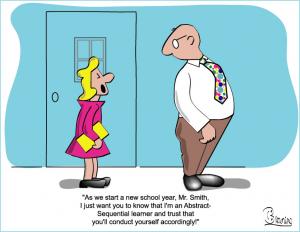
Blog #1 Q5-7 Learning style


Cartoon by Bill Browning, from his webpage: http://www.mnispi.org/cartoon/2001/index.htm.

I am very comfortable in the classroom setting. I have always been one to participate and volunteer to go first in any presentation. In order for me to be completely comfortable in the classroom I look for the following aspects: 1. Equality -The opportunity for everyone to participate, not just focusing entirely on one person. 2. Control - I like for a teacher to have control and redirect people who drift away from the subject to give their own personal dissertation of life. 3. Sticking to the subject at hand - I enjoying conversing just like anyone else, but since time is valuable when I come in to learn about a subject I like to stay in content and limit tangents so I feel I got the most out of the session at hand.

As a student I believe I am an active learner. I keep up with my work and tend to complete tasks immediately. Timeliness is a quality that I prefer in people because I place a high value on my time and other's time. As within my classroom, I find those who aren't prepared have little to offer besides trying to pull others of task. I am extremely focused and am someone who gladly takes the opinion of others into consideration and will rework projects and assignments until they exceed expectations. If I don't understand something I research it until I do. I have no problem asking for clarification because I like to know exactly what is expected of my performance. I enjoy helping others because I feel their insight can often help me see things from a different aspect, all adding to my own knowledge.